|
|

The Rickard range of VAV electronic diffusers has been
developed to be a simple, yet intelligent system that
can work on its own or when integrated into a BMS.
The system aims to provide better thermal comfort
in every part of a building whilst minimising energy
consumption and maintaining effective
air mixing.

1
Supply Air Sensor
Mounted at the neck of the diffuser as
standard to monitor supply air for automatic
heating and cooling mode changeover.
2
Onboard Thermostat
Comes with a built-in thermostat
control under the ceiling diffuser
faceplate to accurately monitor the
temperature within the space.
3
Onboard Occupancy Sensing
Ceiling diffusers come with
occupancy sensing as standard with
every diffuser and can be controlled
via the Rickard MLM software.
4
On-board Master Controller
All diffusers come standard with a
master controller that uses the MLM
software to control the airflow based
on the following parameters: supply air
temperature, room temperature,
and occupancy.
5
Plug-n-play System
A single daisy-chained,
inter-diffuser network cable enables
power and communication to all
diffusers from a central online
system. Each diffuser has an RJ45
terminal for the option to connect
a decentralised thermostat.
6
Built to Last
Rickard diffusers are built with
a robust, powder-coated metal
construction, including the
faceplate, trim-plate, control disc,
and foot-mounts. The diffuser
interface board is protected with a
metal cover and hard-mounted to
the diffuser body.
7
Reduced Commissioning Time
Most Rickard diffusers are set up as
masters since it’s generally preferred
to have individual thermal monitoring
and control at each outlet. By default,
all diffusers are set to master mode and
will automatically assign themselves
to their zone when powered up. If a
diffuser needs to be assigned as a
slave, it can be done using the Rickard
MLM software
Mounted at the neck of the diffuser as
standard to monitor supply air for automatic
heating and cooling mode changeover.
Comes with a built-in thermostat
control under the ceiling diffuser
faceplate to accurately monitor the
temperature within the space.
Ceiling diffusers come with
occupancy sensing as standard with
every diffuser and can be controlled
via the Rickard MLM software.
All diffusers come standard with a
master controller that uses the MLM
software to control the airflow based
on the following parameters: supply air
temperature, room temperature,
and occupancy.
A single daisy-chained,
inter-diffuser network cable enables
power and communication to all
diffusers from a central online
system. Each diffuser has an RJ45
terminal for the option to connect
a decentralised thermostat.
Rickard diffusers are built with
a robust, powder-coated metal
construction, including the
faceplate, trim-plate, control disc,
and foot-mounts. The diffuser
interface board is protected with a
metal cover and hard-mounted to
the diffuser body.
Most Rickard diffusers are set up as
masters since it’s generally preferred
to have individual thermal monitoring
and control at each outlet. By default,
all diffusers are set to master mode and
will automatically assign themselves
to their zone when powered up. If a
diffuser needs to be assigned as a
slave, it can be done using the Rickard
MLM software

Faulty diffusers
automatically
self-isolate to keep
the rest of the network
running.

Improved hot plug protection makes the diffusers more resilient to plugging in components when powered.

Power supplies
have built-in
surge protection.

By utilising an
all-metal construction,
plastic usage within
the diffuser has been
reduced by 60%.
The Rickard range of VAV electronic diffusers uses
a modular system design that is extremely reliable
and easy to install. It can be used with most types of
buildings, regardless of their size, due to the simplicity
of its design and the flexibility of the system software.
It is made up of six core components:
- The Master Communication Unit (MCU)
- On-board master Controller
- Master diffuser
- Wall thermostat
- Diffuser
- Power Supply (PSU)
The system can be very simple with one Rickard
diffuser, controlled by either the on-board master
controller or a wall thermostat.
The system can also be scaled up. A maximum of
60 diffusers can be accommodated on a single Master
Communication Unit (MCU) and multiple MCU’s can
be connected to the BMS if more than 60 diffusers
are required. Up to 15 diffusers can be connected
to a single power supply, and these can be split into
multiple zones.
The diffusers can be individually controlled by either
a wall thermostat or the on-board controller that sends
its signal back to the BMS. The entire system is then
monitored and changes are made through a PC using
the Rickard stand-alone software or a BMS.
Rickard Electronic diffusers have adopted an easy
to install “plug and play” system that uses simple,
automotive grade, daisy chain connections. This helps
to minimise the cost of installation and eliminates the
risk of using the incorrect connectors.
For new installations of Rickard Electronic Diffusers,
duct design that achieves static regain is highly
recommended. If retrofitting to existing ducting that
cannot be changed, a relief ring can be installed
at the end of a duct run to release air pressure when
the diffusers close.

Easy to Install, Zone and Re-Program
Rickard’s MLM software is designed to simplify
the commissioning and management of a diffuser
network with a building. This software allows
for easy configuration of diffuser parameters,
monitoring of the network, and logging diffuser
activity. The software helps reduce the cost of a
BMS connection by decentralising the BMS access
point. It controls a single Master Communications
Unit using BACnet, connecting up to 60 diffusers
in a group and significantly reducing the cost of
connection
With a user-friendly graphic interface, the software
provides easy-to-follow instructions and utilises
simple color-coded diffuser icons for setup and
commissioning. Rickard diffusers are defaulted and
installed as a master, with the option to be converted
to a slave if needed using the MLM software.
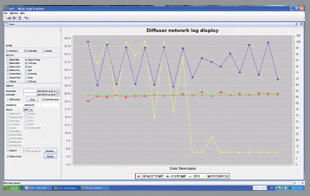
Rickard’s feature-filled MLM-installed software
allows for individual diffuser communication and
monitoring within a building. It includes features such
as minimum and maximum temperature control,
individual set points, occupancy sensing, diffuser
grouping, diffuser isolation (enable/disable),
CO2 monitoring, and fault finding, which
contribute to maintaining a well-balanced VAV
ventilation system, as well as remote building
monitoring and tuning with minimal disturbance
to building occupants.
The software also enables users to view up to 60
diffusers at a time, log faults, and centrally detect
issues for resolution, providing a comprehensive
view of the entire system. Moreover, it offers
the ability to visualize the connectivity of each
diffuser within a zone and allows users to view
data in an easy-to-understand chart by selecting
diffuser parameters. The Rickard system can
be controlled via the MLM software as a
stand-alone ventilation system or can be
integrated into a building management system,
with the BMS having the capability to override
the MLM software when necessary.
Rickard offers a variety of controllers and sensors that can be integrated into a
Building Management System (BMS) to control the HVAC system output based on
changing thermal conditions and maintain comfort. These components automatically
adjust the HVAC system’s operation, modify temperature and airflow volume,
and reduce CO2 levels and demand when spaces are unoccupied.
Each electronic Rickard ceiling diffuser now comes with an onboard thermostat
beneath the diffuser faceplate to accurately monitor the temperature within the
space. Occupancy sensing is a standard feature with every diffuser.
If a wall thermostat is needed, there are several options available.
Wall Thermostat
The standard wall thermostat is also a master controller which enables the occupant to control
the temperature of an allocated space. Typically, the set temperature is displayed, and the
occupant can select a temperature within a preset range, such as between 20°C and 24°C.
Wall Thermostat with CO2
The CO2 wall thermostat has been designed to give accurate room temperature sensing while
controlling CO2 levels via a defined preset level. When the CO2 value rises above the threshold,
the diffusers open fully until the normal CO2 value is reached. The thermostat can also be monitored
by a BMS to adjust the fresh air rates.
Wall Thermostat with Occupancy Sensing
Occupancy sensing is standard in every electronic Rickard VAV diffuser and available as an
option with the wall thermostat. When a room with Rickard occupancy sensing is vacant, the
diffuser will automatically reduce the supply of air to that room. If the room becomes occupied,
the diffuser will return to automatic control. If the diffuser with occupancy sensing is connected
to a BMS, it can also automatically control the room lights.
Wireless Controls
A Rickard system with wireless controls is designed to reduce
the use of cable connections and allow location flexibility of
controllers and sensors. Whether it’s at installation stage or
rearranging an existing floorplan, Rickard wireless controls and
sensors, can be placed anywhere within the building without
disruption to the building’s structure or occupants
Wireless Access Point
A wireless Access Point (AP) can communicate with up to 15
wireless wall thermostats and POD temperature sensors. Multiple
Access Points can be used to match specific project requirements.
Commissioning is made simple with Rickard MLM software and its
intuitive thermostat/diffuser pairing feature.
Wireless Wall Thermostat
The wireless wall thermostat provides individual temperature control
and sensing without compromising on floor plan changes, as well
as helping to reduce the cost of installation. Typically batteries
in a wireless wall thermostat have a 3 year life span.
Wireless POD Temperature Sensor
The POD sensor provides room temperature sensing with wireless
capability making it quick and easy to install. The sensor acts as
a remote sensing station that can be easily moved if a diffuser needs
to be relocated. Typically batteries in a wireless POD temperature
sensor have a 5 year life span.
Air Flow Sensor
Rickard electronic ceiling and linier diffusers are available with air
flow sensing that enables commissioning to occur easier and
faster. Every room can now supply the precise amounts of air
required via a unique air trimming feature. It allows the
ventilation system to be electronically tuned remotely
though the Rickard MLM software without the
requirement of an Air Capture Hood.
Air flow sensors can be fitted
to each Rickard diffuser for
accurate air flow calculations
or to one diffuser per zone to
provide an indication of air
flow in that zone. The air flow
sensing feature also includes a
commissioning mode that allows a
maximum flow value to be limited to
design volumes under maximum load
conditions. This ensures the diffuser does not
supply more air than intended.
Inline Duct Heater
The Rickard VAV diffuser system can include electric inline
duct heaters if additional heating is required for particular zones.
An inline heater can help reduce the energy consumption
in a building. By using them for offices that are typically colder
than the buildings average, it reduces the load on the
central heating system.
- Fitted between the main duct
and the diffuser flex duct
- Adjustable output to ensure
stratification doesn’t occur
- MLM and BMS compatible
|